
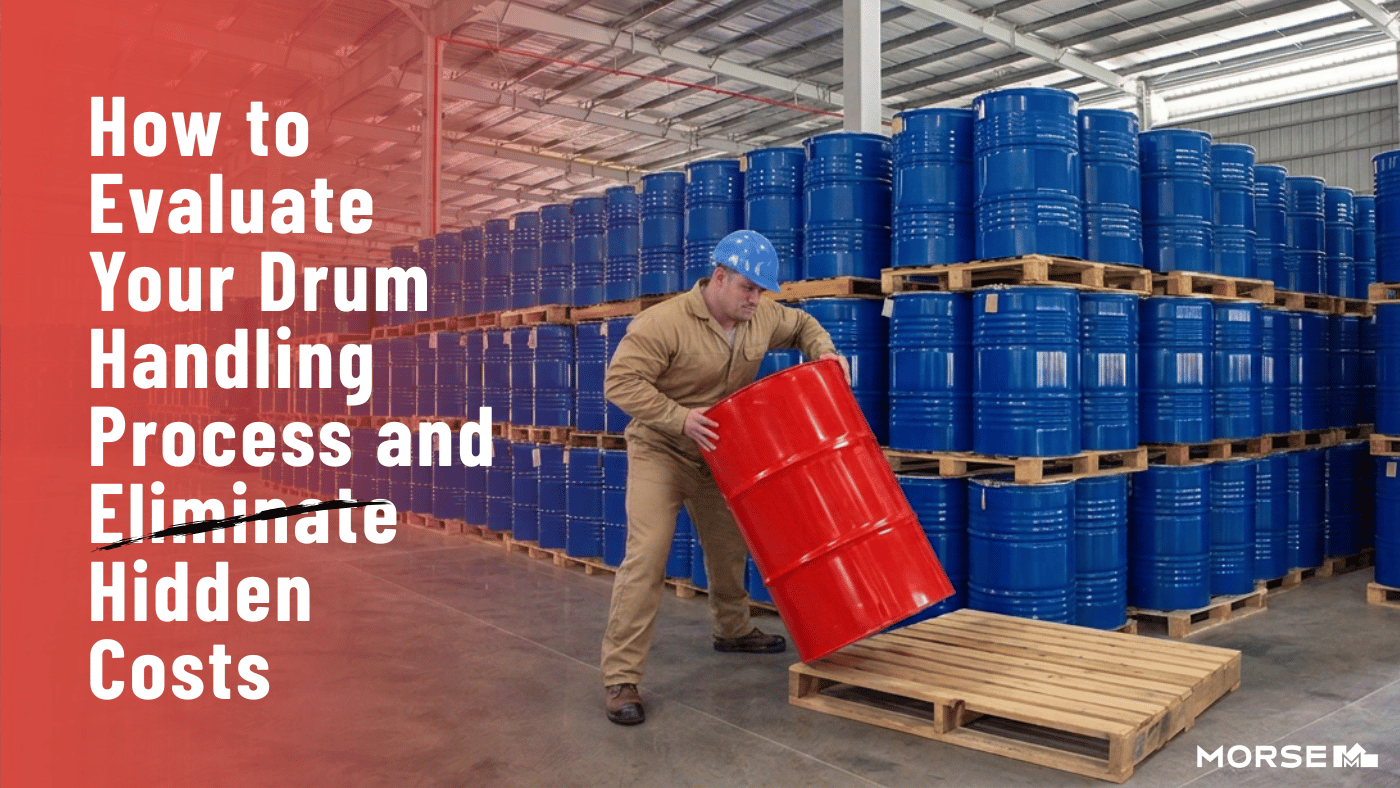
How to Evaluate Your Drum Handling Process and Eliminate Hidden Costs
Every drum handling process develops habits over time. What starts as a temporary workaround or a quick solution can eventually become standard operating procedure.
The challenge is that many of these practices go unquestioned. Employees adapt. Supervisors work around them. Production continues moving forward.
But hidden inefficiencies can quietly increase labor requirements, reduce productivity, create unnecessary physical strain, and impact workplace safety.
When facilities look for ways to improve operations, they often focus on equipment. In reality, the biggest drum handling problem usually isn’t the drum itself.
It’s the extra labor.
It’s the workaround.
It’s the “we’ve always done it this way.”
Hidden Costs in Your Drum Handling Process
Most facilities move, lift, transport, dispense, or weigh drums hundreds or even thousands of times each year.
A few extra minutes here and there may not seem significant. However, when inefficient processes are repeated daily, the impact becomes much more noticeable.
Consider some common examples.
Multiple Employees Required for Routine Tasks
Have you ever seen two employees move a drum because one person cannot safely complete the task alone?
While this may seem normal, it doubles the labor required for a single activity.
Over time, assigning two people to a task that could potentially be completed by one operator can affect productivity and labor utilization throughout the facility.
Forklifts Used as Workarounds
Forklifts are valuable tools, but they are often used to solve problems they were never designed to address.
When operators rely on makeshift methods for lifting, positioning, or transporting drums, the result is often a process that is less efficient, less controlled, and more time-consuming than necessary.
The issue isn’t the forklift itself.
The issue is that the drum handling process may not be optimized for the task at hand.

Excessive Manual Handling
Manual drum handling remains surprisingly common in many operations.
Employees may push, pull, tilt, roll, or reposition drums multiple times throughout the day. These activities become so routine that they are often accepted as part of the job.
Yet every unnecessary movement adds effort, consumes time, and increases physical demands on operators.
Reducing manual drum handling can improve both workplace ergonomics and overall operational efficiency.
Product Loss During Dispensing
Dispensing materials from drums requires control and consistency.
Without a reliable method for positioning and rotating drums, operators may experience spills, inconsistent pour rates, product waste, or lengthy cleanup processes.
Because these challenges occur gradually, many facilities begin to view them as unavoidable.
In reality, they are often signs that the drum handling process could be improved.
How to Evaluate Your Drum Handling Process
One of the simplest ways to uncover hidden costs is to walk through your operation and ask a few questions.
Moving Drums
- Are employees manually pushing or pulling drums?
- Are multiple workers required to move a single drum?
- Are drums difficult to maneuver into position?
- Are forklifts being used as a workaround?

Lifting and Positioning
- Are operators manually adjusting drum placement?
- Do employees struggle to lift or position drums accurately?
- Does loading equipment require extra effort or additional personnel?
Dispensing Operations
- Are spills occurring during product transfer?
- Is pour control inconsistent?
- Is excessive time spent positioning drums for dispensing?

Workplace Ergonomics
- Are employees bending, reaching, lifting, pushing, or pulling unnecessarily?
- Are repetitive handling tasks creating avoidable strain?
- Could the process be completed with less effort?
Even one “yes” answer may indicate an opportunity to improve your drum handling process.
Improving Drum Handling Safety and Efficiency
The goal of improvement is not simply to move drums faster.
The best drum handling processes improve safety, productivity, consistency, and operator control simultaneously.
Often, the greatest gains come from small changes that eliminate unnecessary steps.
These improvements can help facilities:
- Reduce manual effort
- Improve workplace ergonomics
- Increase operator productivity
- Improve process consistency
- Minimize product waste
- Enhance drum handling safety
Facilities that regularly review their processes are often surprised by how many inefficiencies have become normalized over time.
Small Process Improvements Create Long-Term Results
Operational excellence is usually not the result of one major change. It comes from identifying small sources of waste and continuously improving them. A drum moved more efficiently. A dispensing task completed with greater control. A process that no longer requires two employees when one can safely perform the work.
These improvements may seem modest on their own, but the benefits accumulate over hundreds and thousands of drum handling activities each year.
Start with a Fresh Perspective
If your facility handles drums regularly, take a step back and evaluate your current drum handling process.
Look for the workarounds.
Question the extra steps.
Challenge the assumption that “this is how we’ve always done it.”
Because the biggest drum handling problem usually isn’t the drum.
It’s everything surrounding it.
Is Your Drum Handling Process Working as Efficiently as It Could?
Download our free Safer Drum Handling Starts with Morse guide to identify hidden inefficiencies, evaluate workplace risks, and uncover opportunities to improve safety, productivity, and operator control.



No responses yet