
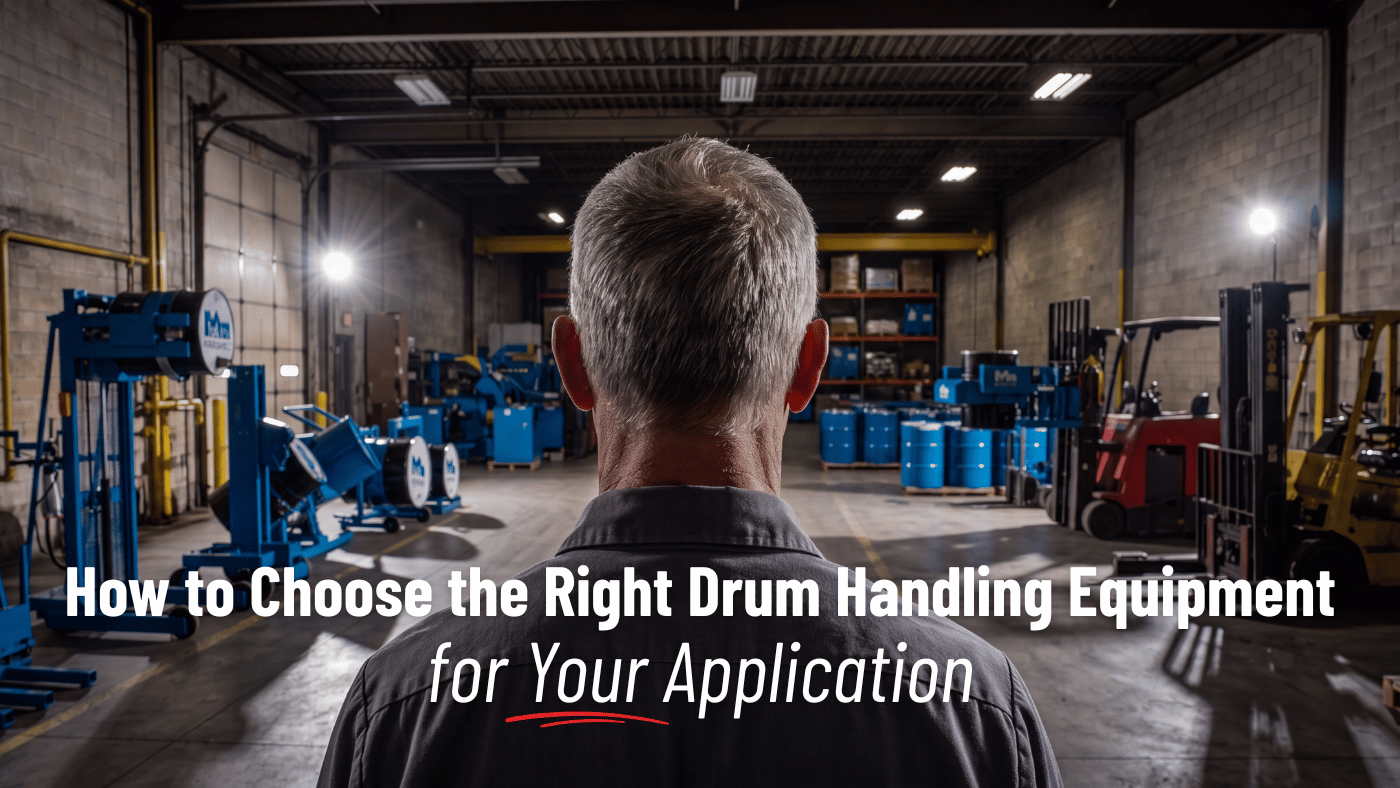
How to Choose the Right Drum Handling Equipment for Your Application
When it comes to drum handling, there is no one-size-fits-all solution.
The right equipment depends on how drums move through your facility, what tasks operators perform, safety requirements, and production goals. Choosing equipment that aligns with your application can help improve productivity, reduce manual handling risks, and create a safer, more efficient workplace.
If you’re evaluating drum handling equipment, start by identifying what you’re trying to accomplish.

Are You Trying to Lift Drums?
Many operations need to lift drums for loading, unloading, positioning, mixing, or transferring materials.
The best lifting solution depends on your available equipment and how frequently the task is performed.
Consider These Questions:
- Are drums lifted using a crane or hoist?
- Do operators need to position drums precisely?
- Are drums lifted from floor level?
- Do drums need to be transported after lifting?
Recommended Solutions
Below-Hook Drum Handlers
Designed for use with overhead cranes and hoists, below-hook handlers make it easy to secure, lift, and position drums while maintaining operator safety.
Mobile Drum Handlers
An ideal choice for facilities that need to lift and transport drums with one versatile piece of equipment.
Forklift Drum Handlers
Convert existing forklifts into drum lifting equipment while maximizing the value of your material handling fleet.
Common Applications
- Manufacturing facilities
- Chemical processing
- Food and beverage production
- Warehousing and distribution
- Pharmaceutical operations

Are You Trying to Move Drums?
Moving drums throughout a facility is one of the most common material handling tasks.
Whether transporting drums between workstations, moving inventory into storage, or delivering materials to production areas, the right equipment can reduce strain and improve workflow efficiency.
Consider These Questions:
- How far do drums need to travel?
- Are drums moved frequently throughout the day?
- Will they be transported by forklift or manually?
- Do operators need to maneuver through tight spaces?
Recommended Solutions
Drum Trucks
A practical solution for transporting drums short distances while maintaining control and stability.
Mobile Drum Handlers
Combine lifting and transportation capabilities in one versatile machine.
Forklift Attachments
A cost-effective way to move drums using equipment already present in the facility.
Common Applications
- Shipping and receiving
- Warehouse operations
- Production support
- Inventory management

Are You Trying to Pour Drum Contents?
Dispensing materials from drums presents unique challenges. Operators often need to control the flow of material while minimizing spills, reducing waste, and maintaining ergonomic working conditions.
Consider These Questions:
- How often are drums poured?
- What pour height is required?
- Are drums moved between workstations?
- Is precise drum positioning important?
Recommended Solutions
Mobile Drum Handlers
Lift, transport, and pour drums from a single piece of equipment.
Below-Hook Drum Handlers
Position and dispense drum contents using existing cranes and hoists.
Forklift Attachments
Utilize forklifts for handling and pouring drums efficiently while reducing manual effort.
Drum Palletizers
Improve handling efficiency in operations where drums are frequently loaded, unloaded, or positioned during production processes.
Common Applications
- Chemical dispensing
- Ingredient transfer
- Production batching
- Manufacturing operations

Is Improving Safety Your Primary Goal?
Safety improvements are often the result of implementing the right drum handling process.
Manual lifting, pushing, pulling, and positioning of drums can increase the risk of workplace injuries and operational inefficiencies.
Purpose-built drum handling equipment helps create safer and more consistent processes while reducing physical demands on operators.
Common Safety Challenges
- Manual drum movement
- Ergonomic strain
- Uncontrolled drum handling
- Product spills
- Repetitive lifting tasks
How Drum Handling Equipment Can Help
- Reduce manual lifting
- Improve control during drum handling
- Minimize product spills
- Improve ergonomic working conditions
- Create more consistent operating procedures

Five Questions to Ask Before Choosing Drum Handling Equipment
Before selecting equipment, consider the following:
1. How Much Does the Drum Weigh?
Different equipment is designed for different load capacities. Understanding the weight of a full drum is critical when evaluating options.
2. What Type of Drum Are You Handling?
Steel, plastic, and fiber drums may require different handling approaches.
3. What Are You Trying to Accomplish?
Lifting, moving, pouring, transporting, stacking, and positioning all require different solutions.
4. What Equipment Is Already Available?
Forklifts, cranes, and hoists can often be leveraged with specialized drum handling attachments.
5. How Frequently Is the Task Performed?
A daily production application may benefit from a different solution than occasional drum handling tasks.
Find the Right Drum Handling Solution
For more than 100 years, Morse Manufacturing has helped companies improve drum handling safety, efficiency, and productivity through purpose-built equipment and application expertise.
Whether you’re lifting, moving, pouring, transporting, or positioning drums, our team can help identify the right solution for your operation.
Need help selecting equipment for your application?



No responses yet