
Built for Manufacturing: 5 Ways Better Drum Handling Supports a Safer, More Efficient Operation
Manufacturing is built on processes.
From raw materials arriving at a facility to finished products heading out the door, every step depends on people, equipment, and systems working together. And while some processes receive more attention than others, seemingly small tasks can have a significant impact on the way work gets done.
Drum handling is one of them.
Across manufacturing environments, drums may need to be moved, lifted, positioned, stored, weighed, mixed, or emptied as part of a larger production process. When those tasks rely too heavily on manual effort or require multiple handling steps, they can introduce unnecessary challenges into the operation.
As we celebrate Manufacturing Month, we’re taking a closer look at five ways manufacturers can improve drum handling to support safer, more efficient processes.
1. Reduce Unnecessary Manual Handling
A full drum is not something operators should have to wrestle into position.
Yet manual pushing, pulling, repositioning, and other workarounds can become part of the routine simply because “that’s how we’ve always done it.”
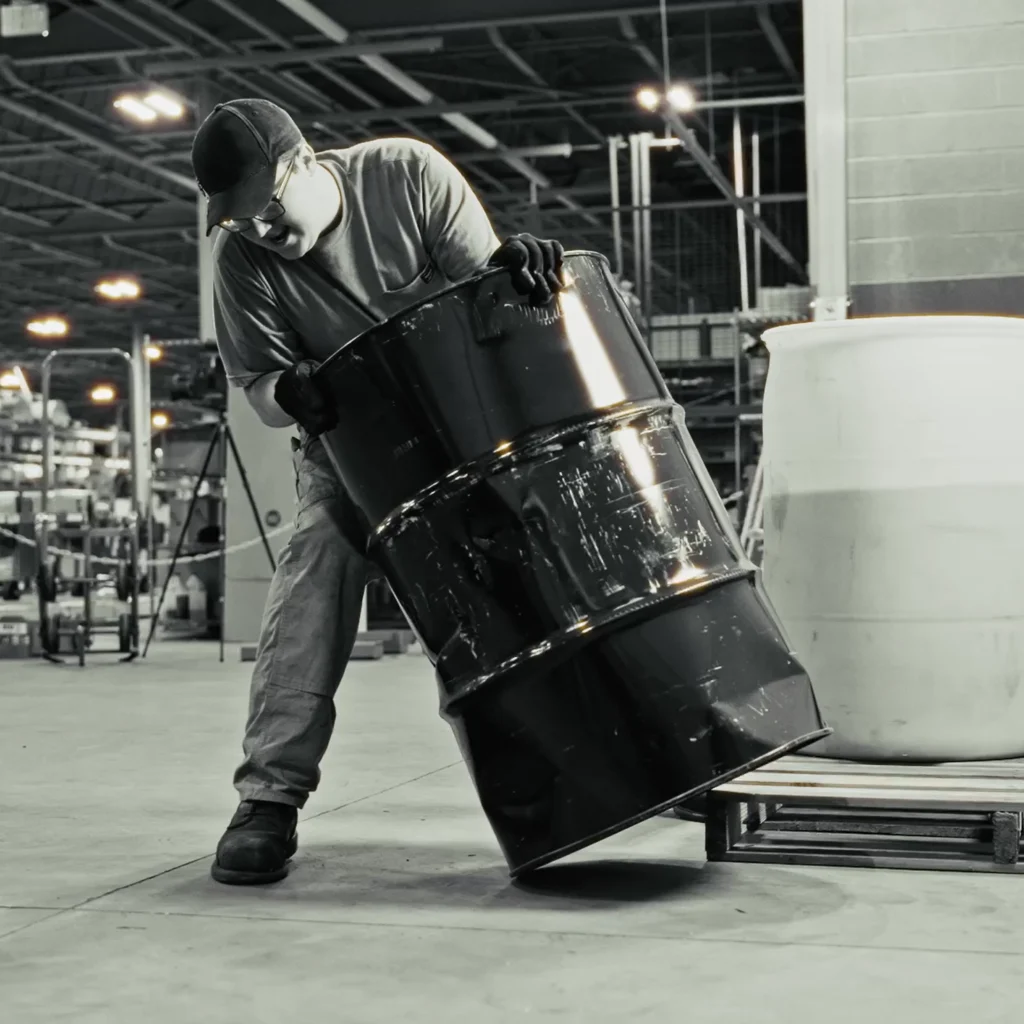
One of the first steps toward improving a drum handling process is identifying where employees are providing the muscle that equipment could provide instead.
Look for situations where:
- Multiple employees are needed to move or position a drum
- Drums are manually pushed or pulled through a facility
- Frequent repositioning is required
- Operators have difficulty controlling a drum during movement
- Forklifts or other equipment are being used as workarounds for drum handling tasks
Using equipment designed specifically for the task can reduce manual effort while giving operators greater control over the drum.
The goal isn’t simply to automate for the sake of automation. It’s to match the equipment to the task and remove unnecessary physical effort from the process.
2. Make Lifting and Positioning More Controlled
Moving a drum across the floor is often only part of the job.
Manufacturing processes may require drums to be loaded onto pallets, placed in storage racks, positioned near production equipment, raised to a dispensing height, or moved into very specific locations.
Each additional step creates another opportunity to ask:
Is there a better way to do this?
Mechanical drum lifting and positioning equipment can help operators place drums where they’re needed without relying on manual lifting or repeated repositioning.
The right solution depends heavily on the application. A manufacturer positioning drums on pallets has very different requirements from a facility lifting a drum above process equipment for dispensing.
That’s why it’s important to start with the task, not the equipment.
3. Improve the Pouring and Dispensing Process
For many manufacturers, drum handling doesn’t end once the drum reaches its destination. The contents still need to get where they’re going.
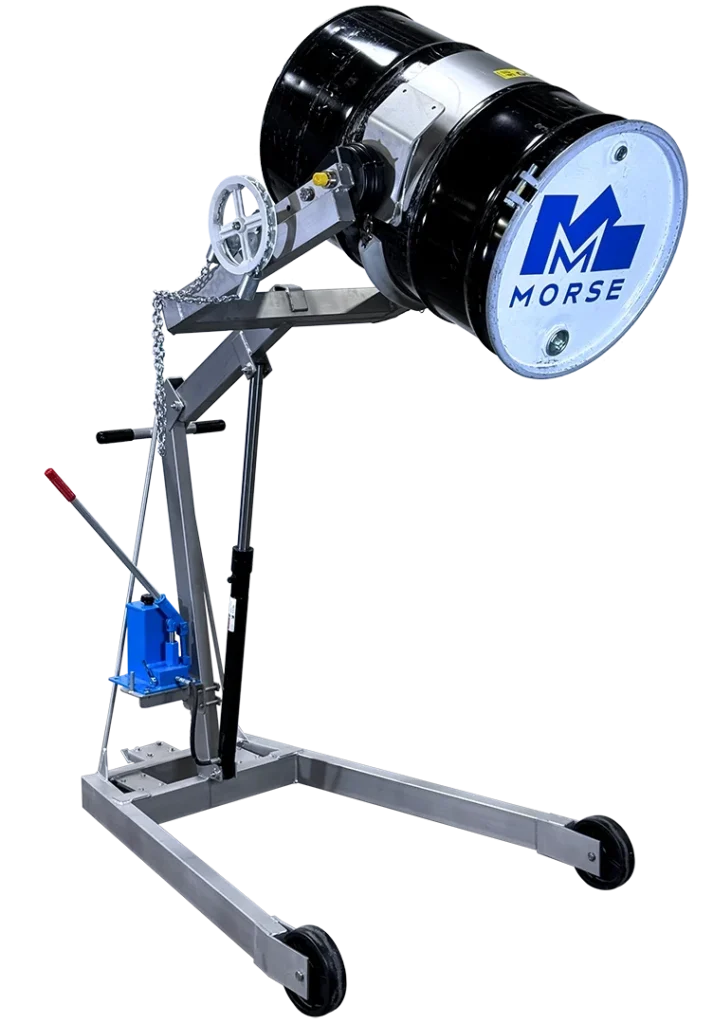
That might mean pouring an ingredient into a mixing vessel, dispensing material into a smaller container, or controlling the flow of a process material.
This is where positioning and control become especially important.
An effective drum dispensing process should consider the entire sequence:
Move → Lift → Position → Rotate → Dispense
If each stage requires another piece of equipment, another operator, or another manual adjustment, there may be an opportunity to simplify the workflow.
Equipment that provides controlled drum rotation and better positioning can help operators manage the dispensing process with greater control while reducing unnecessary handling.
4. Look for Opportunities to Combine Handling Steps
One of the best ways to evaluate any manufacturing process is to look at how many times a material has to be handled.
Consider a drum that needs to be transported, weighed, positioned and eventually dispensed.
Does the drum need to move between several pieces of equipment to accomplish those tasks? Does an operator have to repeatedly reposition it? Could some steps be combined?
Modern drum handling equipment can increasingly perform several functions within a single handling process.
For example, Morse’s PILOT™ power-propelled drum handlers combine powered transport, drum lifting and powered 360-degree drum rotation. The scale-equipped Model 545 also adds integrated weighing for applications involving batching, dispensing, and process materials.
That doesn’t mean every operation needs an all-in-one solution.
It means manufacturers should periodically step back and look at the entire material handling process, not just each individual task.
Reducing unnecessary transfers or repositioning can simplify workflows and make better use of both equipment and employees.
5. Choose Drum Handling Equipment Around the Application
There’s no single “best” way to handle a drum.
The right solution depends on what you’re doing, what you’re handling, and where you’re doing it.
Before selecting equipment, start with a few basic questions:
What does the drum need to do?
Does it need to be:
- Moved?
- Lifted?
- Poured?
- Weighed?
- Mixed?
- Positioned or stored?
What type of drum are you handling?
Consider:
- Steel
- Plastic
- Fiber
- Drum size
- Drum weight and contents

Where will the equipment be used?
Requirements can vary between general manufacturing, food processing, chemical manufacturing, pharmaceutical operations, hazardous environments, and other specialized applications.
What type of operation makes sense?
Depending on the application, equipment may be manual, electric, air-powered, or use another configuration designed around the task.
These are many of the same considerations included in Morse’s Safer Drum Handling Starts with Morse Guide, which is designed to help facilities examine their current processes and identify opportunities to reduce manual effort and improve drum handling.
Starting with the application helps narrow the options and prevents a common mistake: choosing a piece of equipment first and then trying to make the process fit it.
Small Improvements Can Make a Difference
Manufacturing efficiency isn’t always about completely redesigning a production line.
Sometimes it’s about looking closely at the individual processes happening throughout a facility and asking whether there’s a safer, simpler, or more efficient way to accomplish them.
Drum handling is one of those processes.
If employees are repeatedly moving, lifting, repositioning, weighing, or dispensing drums, take a fresh look at how those tasks are being performed. Removing even a few unnecessary handling steps can improve the overall process.
Dedicated to Manufacturing
Manufacturing Month is an opportunity to recognize an industry built on skill, innovation, problem-solving, and people. National Manufacturing Day and the broader Manufacturing Month initiative are designed in part to showcase modern manufacturing and the careers that keep the industry moving forward.
At Morse, we’re proud that our role in that larger story is helping manufacturers solve drum handling challenges.
For more than 100 years, we’ve focused on equipment for moving, lifting, positioning, weighing, pouring, and handling drums across manufacturing and processing applications.
As Manufacturing Month comes to a close, we celebrate the people behind the processes and remain proud to be dedicated to the manufacturing industry.
Ready to take a closer look at your drum handling process?
Explore Morse drum handling solutions or talk with a Drum Handling Specialist to find the right approach for your application.



No responses yet